what does cat 5 michael mean to home owners?
| In a higher place: A homo walks through a beachfront neighborhood that was decimated past Hurricane Michael on October 16, 2018 in Mexico Beach, Florida. The neighborhood, which had homes near of the way to the beach earlier the storm, was flattened by Michael's storm surge. Image credit: Scott Olson/Getty Images. |
As an intensifying Hurricane Michael roared aground in Florida's Panhandle as a top-stop Category 4 tempest with 155 mph winds on October 10, 2018, it pushed a massive and subversive storm surge to the coast. The peak tempest surge, located forth the right side of where the eyewall made landfall, hit the town of Mexico Embankment, which suffered devastating storm surge harm. Michael killed 45 people and caused harm in backlog of $fifteen billion, co-ordinate to an estimate terminal calendar week from insurance broker Aon. In a post-storm survey, the United States Geological Survey (USGS) found at least three high-quality still-water marks between 17 - 19' higher up hateful sea level (MSL) in Mexico Embankment, taken within of buildings where waves could not accomplish. These marks are likely a expert measure of Michael's height tempest tide (top higher up MSL of the tempest surge plus the tide), according to Dr. Robert Young, director of Western Carolina Academy's Program for the Study of Developed Shorelines.
 |
| Figure 1. A loftier-h2o mark 19.06' higher up mean body of water level from Hurricane Michael was recorded inside this home in Mexico Beach, FL. The horizontal layering of the debris lines show that waves could not attain this location, and so 19.06' may be an accurate measure of the hurricane's storm tide. Paradigm credit: USGS. |
Michael'south storm tide, when combined with waves on top of the surge, brought a loftier h2o mark (HWM) of 20.6' higher up mean sea level to a storm tide sensor attached to the Mexico Beach Pier. The mobile sensor, installed just before the tempest by the USGS, measured a tempest tide of fifteen.5', and so waves on summit of the surge were most 5' loftier. A higher HWM of 21.2' was measured in the interior of a habitation in Port St. Joe, which adjoins Mexico Beach to the southeast. This mark was considered of lower quality ("fair").
 |
| Figure 2. Water level (grey line) and storm tide (blueish line) from a tempest tide sensor fastened to the Mexico Beach Pier during Hurricane Michael. The sensor measured a maximum storm tide of 15.55', and 5' waves on top of the surge brought a superlative water level of 20.vi'. Data from a force per unit area sensor attached to a nearby post is shown in red. Paradigm credit: USGS. |
A map of the location and magnitude of three of these high-quality storm tide measurements, forth with the measurement from the storm tide sensor on the Mexico Embankment Pier, was created by Dr. Young's grouping (Figure three). If we decrease off the 0.5' needed to convert to storm surge (the tide was most 4" to a higher place MSL, and an additional 2" correction needs to exist made for the conversion between MSL and the NAVD 88 vertical datum), we get an estimate of fifteen' – 18.v' for the peak storm surge from Hurricane Michael. NOAA has not all the same announced their official numbers for Michael's tempest surge, however.
 |
| Figure iii. The U.s.a. Geological Survey (USGS) found at least 4 high-quality still water marks betwixt xv.5' – 19' above mean ocean level (MSL) in Mexico Embankment, Florida, from Hurricane Michael. 3 of these were nonetheless-h2o marks inside buildings (marked in blue) and 1 was from a storm surge sensor mounted on the Mexico Beach Pier (marked in green). Image credit: Western Carolina University's Program for the Study of Developed Shorelines. |
Michael's high water mark one of the six highest in 85 years of U.Due south. records
According to a database of high water marks of landfalling U.South. hurricanes from 1933 – 2017 compiled by Katie Peek of Western Carolina University, the pinnacle loftier water marks of 20.6' - 21.2' in Mexico Beach would put Michael in fifth or 6th place for highest water levels ever recorded from a U.S. landfalling hurricane since 1933. The database, which culls information from 36 sources—primarily publications past NOAA, USGS, and FEMA—lists twenty hurricanes with maximum loftier-water marks in backlog of xv feet to a higher place normal (including Michael):
Katrina, 2005: 34.11' above MSL at Biloxi, MS (Cat 3)
Camille, 1969: 24.6' higher up MSL at Pass Christian, MS (Cat 5)
Carla, 1961: 22' above MSL at Calhoun Canton, TX (Cat iv)
Opal, 1995: 21.five' above MSL at Mirimar Beach, FL (Cat iii)
Michael, 2018: twenty.half-dozen' - 21.2' higher up MSL at Mexico Beach, FL (True cat 4)
Irene, 2011: 20.77' in a higher place NAVD at Lido Beach, NY (Cat i)
Audrey, 1957: 20.3' above MSL at St. James Parrish, LA (Cat 3)
Hugo, 1989: 20.2' to a higher place NGVD at Awendaw, SC (Cat 4)
Isaac, 2012: 19.seven' higher up NAVD at Harrison Canton, MS (Cat 1)
Ike 2008: 19.4' to a higher place NGVD at Loftier Island, TX (Cat ii)
Sandy, 2012: eighteen.98' above NAVD at Monmouth, NJ (Cat ane)
Hazel, 1954: 18' above MSL at Sunset Embankment, NC (Cat 4)
Rita, 2005: 17.eight' above NGVD at Creole, LA (Cat 3)
Andrew, 1992: 17.2' above MSL at Perrine, FL (Cat 5)
Isabel, 2003: 16.24' above NGVD at Kill Devil Hills, NC (True cat 2)
Long Island Express, 1938: 15.viii' above MSL at Providence/Kent County, RI (Cat 3)
Fran, 1996: fifteen.iv' above MSL at New Hanover County, NC (True cat three)
Carol, 1954: fifteen.1' above MSL at Kent Canton, RI (Cat 3)
Ione, 1955: fifteen.1' above MSL at River Bend, NC (True cat three)
Floyd, 1999: xv' above NGVD at New Hanover County, NC (Cat 2)
Technical annotation: all storm surge measurements are referenced either to MSL or to a vertical datum, NGVD 29 or NAVD 88. NGVD 29 is a geodetic reference system adult by the National Geodetic Survey that is based on surveys taken in 1929. Due to subsidence of the land and the global bounding main level rise of about 8 inches over the past century, the 26 coastal stations used for these surveys take inverse in their elevation relative to true MSL considerably since 1929. In the Mid-Atlantic states, NGVD 29 thinks hateful bounding main level lies 0.v - 1.9 feet beneath present-twenty-four hour period mean sea level (PDF File). The more than contempo NAVD 88 reference arrangement is of superior accurateness in most locations. The difference between NAVD 88 and MSL in the Florida Panhandle is merely about 2 – 3".
The all-fourth dimension record for highest U.S. storm surge is Hurricane Katrina'southward 27.8 feet in Pass Christian, Mississippi in 2005 (measured from a "even so water" marking found inside a building where waves couldn't accomplish). However, the highest high-water mark from Katrina was much higher: a mind-boggling 34.1 feet above hateful level, measured on the exterior of a building in Biloxi, Mississippi, where a high tide of about 1 foot combined with eleven-foot high waves on elevation of the 22-foot storm surge to create the 34.1-human foot high water mark. Note that the database does not take information from the strongest hurricane ever recorded to hitting the U.S.—the 1935 Labor Day storm in the Florida Keys (185 mph winds, 892 mb pressure). That hurricane was reputed to have caused a storm surge of upward to 20 feet, merely there were no reliable measurements of the surge taken.
 |
| Figure 4. Larger-scale view of high-water marks from the U.s.a. Geological Survey (USGS) for Hurricane Michael. Image credit: Blair Tormey, Katie Peek, Rob Young, Western Carolina Academy's Program for the Study of Developed Shorelines. |
 |
| Effigy v. Forecast from October 9, 2018 of storm surge heights above dry footing by NHC. The surge forecast was good, more often than not inside two feet of the actual h2o heights measured (note that since NHC references their forecasts to the high tide marker, not MSL, one needs to add nigh another human foot to these numbers to compare them to the high-water marks in Figures 3 and 4, since Michael did non hit at loftier tide). Image credit: weather.com. |
Similar findings were sent to us by John Garner, a structural engineer who surveys damaged buildings after floods and storms:
"I've been working in Panama City and Mexico Beach...wow. What a mess. The worst wind harm I've seen since Andrew, and a storm surge pretty shut to Ike.
"Office of what we do is delineate current of air damage versus inundation damage, and today I was surveying some h2o heights. I measured two in Mexico Beach, both forth the culvert that y'all may have seen photos of. These are still water heights, where floodwaters rose and stood earlier receding, and both readings were inside the remains of buildings, and didn't include wave heights.
"In both cases I measured between 16.five' and 17' above sea level. That'south about a match for the highest I plant in Ike, and slightly college than Ivan. I constitute another loftier-water marker that looks like it is shut to eighteen', but I have not verified the survey data so it's only preliminary. Looking at the devastation here it is amazing that the loss of life was every bit minor as it was. Even though Panama City was really hammered by the west eyewall, nosotros were fortunate that the tempest took a right plough. Had the eye gone to the left of the metropolis and driven an eighteen' storm surge up that bay, information technology could have been much worse.
"For the record, a proprietary radar wind program from a individual visitor showed 152 mph 3-2nd gusts in Mexico Beach. That is tiptop cease EF3 damage, and information technology's pretty consistent with the damage I saw."
 |
| Figure vi. Approximately eighty% of all the structures in Mexico Beach were destroyed or severely damaged past Hurricane Michael's storm surge in an surface area mapped equally minimal flood hazard (FEMA'southward Ten Zone, grey color). None of these 200 structures would have been required to carry flood insurance (but zones 5 and A, orange and blue colors, were required to). Paradigm credit: Blair Tormey and Katie Peek of Western Carolina University. |
FEMA flood maps for Mexico Embankment were outdated
A property owner is required to carry flood insurance when the official Federal Emergency Management Agency (FEMA) flood map for the location shows a 1-in-100-year take a chance or higher of flooding (an event that has at to the lowest degree a one% adventure of happening in whatsoever given year). Yet, approximately fourscore% of all the structures in Mexico Beach were destroyed or severely damaged by Hurricane Michael's storm surge in an area defined as an area of minimal flood take a chance, outside of the 0.two% annual chance flood (or 1-in-500-year flood). These homes were generally at an elevation of 6 to 17 feet to a higher place sea level. Given that Hurricane Michael was the third or fourth strongest hurricane on record ever to hit the continental U.South., a 1-in-500 year overflowing risk estimate may not have been far off. Still, with ocean level rise accelerating and climate change expected to make the strongest hurricanes stronger and more numerous, the coastal flood risk will be steadily increasing in the coming decades.
Co-ordinate to an article in Inside Climate News, FEMA terminal updated its inundation maps for United mexican states Beach in 2009, based on a maximum storm surge of 10 feet. County officials are working on revisions but declined to exist interviewed. FEMA is supposed to review their maps every five years to make sure they still properly bespeak flood risk, just a 2017 report by Bloomberg found some FEMA inundation maps to be equally former as from the 1970s. Merely 42 per centum of the FEMA maps "adequately identified the level of inundation gamble", co-ordinate to a 2017 written report from the Department of Homeland Security's Inspector General's Function.
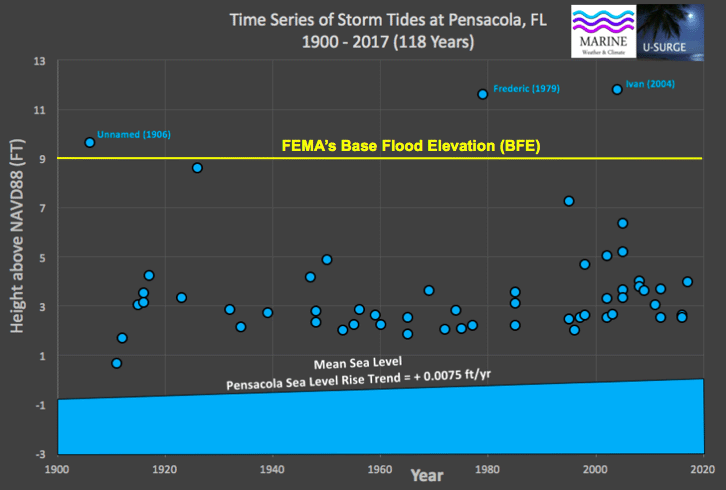 |
| Figure 7. Tempest tide history for Pensacola, Florida, from the U-Surge Project. The highest water levels (tempest tides) since 1900 are plotted, forth with FEMA's threshold for a 1-in-100 year flood (the Base Inundation Elevation, or BFE, shown as a xanthous line at nine feet above sea level). Three storm tides since 1900 take exceeded FEMA'southward BFE, and if ocean level rising is added to the 1926 tempest tide, that upshot as well would exceed BFE today. Thus, what FEMA calls a 100-year-overflowing would really be more than like a 25- or 30-year h2o level from a data-driven perspective. Epitome credit: Dr. Hal Needham, U-Surge Project. |
FEMA generates their flood maps based on historic flood data, and through modeling of the adventure in the current climate. According to storm surge skillful Dr. Hal Needham, this procedure is oft questionable: "When I accept built storm surge histories for littoral cities, typically three or 4 historical storm surge events have exceeded FEMA'southward Base Flood Elevation (BFE), which is synonymous with the 100-year flood level. Then what FEMA calls a 100-year flood level would really be more like a 25- or 30-year water level from a data-driven perspective."
FEMA does non take into account predictable future sea levels or climate change. This might be OK if the FEMA maps were updated every v years as required, only old FEMA maps from decades ago are going to seriously underestimate alluvion hazards in many cases, due to climate change. Bad information about an area'due south flood risk can leave the National Flood Insurance Program (NFIP) and homeowners vulnerable to loftier costs from flood damage. NFIP is currently $20.5 billion in debt, even after Congress cancelled $16 billion in debt due to 2017 claims from the destruction wrought by Hurricanes Harvey, Irma and Maria.
In the case of fresh water flooding, more 40 1000000 Americans are exposed to flood run a risk at the 1-in-100-year overflowing level, about three times more than the thirteen meg when calculated using FEMA's flood maps, a Feb study in the journal Environmental Research Letters concluded.
Related cat6 posts
Retreat from a Ascent Sea: A Book Review (February 2018)
Sea Level Ascent is Accelerating, Says Unnerving New Research (February 2018)
Our Dec review of Jeff Goodell's 2017 must-read volume on ocean level rise,The Water Volition Come:Ascent Seas, Sinking Cities, and the Remaking of the Civilized World
Why Is It So Hard to Set up the National Flood Insurance Program? (November 2017)
Blockbuster Assessment: Humans Likely Responsible For Well-nigh All Global Warming Since 1950s (November 2017)
mcmullinwerseemse.blogspot.com
Source: https://www.wunderground.com/cat6/Hurricane-Michael-Brought-Water-Levels-Over-20-High-Coast
0 Response to "what does cat 5 michael mean to home owners?"
Postar um comentário